Domestic Workers Bill of Rights Act
USA119th CongressHR-3971| House
| Updated: 6/12/2025
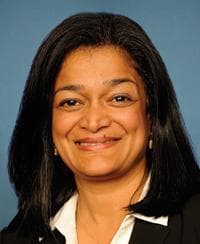
Pramila Jayapal
Democratic Representative
Washington
Cosponsors (114)
Dwight Evans (Democratic)Donald Norcross (Democratic)Nikema Williams (Democratic)Yassamin Ansari (Democratic)Becca Balint (Democratic)Laura Friedman (Democratic)John Garamendi (Democratic)Jonathan L. Jackson (Democratic)Sylvia R. Garcia (Democratic)Jared Huffman (Democratic)Gabe Amo (Democratic)Robin L. Kelly (Democratic)Ritchie Torres (Democratic)Robert Garcia (Democratic)Mark Pocan (Democratic)Robert Menendez (Democratic)Joyce Beatty (Democratic)Jennifer L. McClellan (Democratic)Christopher R. Deluzio (Democratic)Emanuel Cleaver (Democratic)Darren Soto (Democratic)Ilhan Omar (Democratic)Shontel M. Brown (Democratic)Greg Landsman (Democratic)David Scott (Democratic)Frederica S. Wilson (Democratic)Juan Vargas (Democratic)Terri A. Sewell (Democratic)Troy A. Carter (Democratic)Steven Horsford (Democratic)Maxine Dexter (Democratic)Eric Swalwell (Democratic)Maxwell Frost (Democratic)Debbie Dingell (Democratic)Madeleine Dean (Democratic)Melanie A. Stansbury (Democratic)Steve Cohen (Democratic)Suzan K. DelBene (Democratic)Andrea Salinas (Democratic)Delia C. Ramirez (Democratic)Rosa L. DeLauro (Democratic)Greg Casar (Democratic)Haley M. Stevens (Democratic)Adriano Espaillat (Democratic)Shri Thanedar (Democratic)Danny K. Davis (Democratic)Ted Lieu (Democratic)Ro Khanna (Democratic)Jasmine Crockett (Democratic)Henry C. "Hank" Johnson (Democratic)Sheila Cherfilus-McCormick (Democratic)Al Green (Democratic)Nikki Budzinski (Democratic)André Carson (Democratic)Brendan F. Boyle (Democratic)Joaquin Castro (Democratic)Stephen F. Lynch (Democratic)Mark DeSaulnier (Democratic)Jill N. Tokuda (Democratic)Emilia Strong Sykes (Democratic)Doris O. Matsui (Democratic)Sara Jacobs (Democratic)Marilyn Strickland (Democratic)Daniel S. Goldman (Democratic)Gregory W. Meeks (Democratic)Jahana Hayes (Democratic)Raja Krishnamoorthi (Democratic)Jerrold Nadler (Democratic)LaMonica McIver (Democratic)Alma S. Adams (Democratic)Mark Takano (Democratic)Betty McCollum (Democratic)Eleanor Holmes Norton (Democratic)Val T. Hoyle (Democratic)Bonnie Watson Coleman (Democratic)Mary Gay Scanlon (Democratic)Wesley Bell (Democratic)Lateefah Simon (Democratic)Mike Quigley (Democratic)Donald S. Beyer (Democratic)Sean Casten (Democratic)Janice D. Schakowsky (Democratic)James P. McGovern (Democratic)Alexandria Ocasio-Cortez (Democratic)Summer L. Lee (Democratic)Adam Smith (Democratic)Nydia M. Velázquez (Democratic)Julia Brownley (Democratic)Cleo Fields (Democratic)Seth Magaziner (Democratic)Sarah McBride (Democratic)Yvette D. Clarke (Democratic)Bennie G. Thompson (Democratic)Deborah K. Ross (Democratic)Lori Trahan (Democratic)Suzanne Bonamici (Democratic)Linda T. Sánchez (Democratic)Emily Randall (Democratic)Nanette Diaz Barragán (Democratic)Jesús G. "Chuy" García (Democratic)Kevin Mullin (Democratic)Teresa Leger Fernandez (Democratic)Gwen Moore (Democratic)Jimmy Gomez (Democratic)Grace Meng (Democratic)Valerie P. Foushee (Democratic)Rashida Tlaib (Democratic)Kweisi Mfume (Democratic)Ayanna Pressley (Democratic)Veronica Escobar (Democratic)Lloyd Doggett (Democratic)Debbie Wasserman Schultz (Democratic)Chellie Pingree (Democratic)Judy Chu (Democratic)
Committees (6)
• Committee on House Administration• Ways and Means Committee• Judiciary Committee• Energy and Commerce Committee• Education and Workforce Committee• Oversight and Government Reform Committee
- Introduced
- In Committee
- On Floor
- Passed Chamber
- Enacted
The Domestic Workers Bill of Rights Act seeks to significantly enhance the labor rights and protections for an estimated 2.2 million domestic employees in the United States, including those providing direct care, child care, and house-cleaning services. The bill addresses historical exclusions and vulnerabilities faced by this workforce, which is predominantly composed of women, women of color, and immigrants, by extending federal labor and civil rights protections. Key provisions amend the Fair Labor Standards Act of 1938 (FLSA) to grant overtime protections to live-in domestic employees, repealing previous exemptions. It also mandates specific termination notices and communication rights for live-in domestic employees, requiring 48-hour written notice and either 30 days of lodging or two weeks' severance pay, with exceptions for good faith allegations of harmful conduct. Employers must also provide reasonable access to telephone and internet services. The bill introduces a new subtitle establishing comprehensive domestic employee rights, starting with a requirement for written agreements for employees working at least 8 hours per week. These agreements must detail responsibilities, pay rates, work schedules, meal and rest breaks, and termination policies, while prohibiting predispute arbitration and non-compete clauses. Employers are also required to provide earned sick days , allowing employees to accrue at least one hour of paid sick time for every 30 hours worked, up to 56 hours annually, for personal or family health needs, or issues related to domestic violence, sexual assault, or stalking. To promote stability, the legislation mandates fair scheduling practices , requiring employers to provide 72-hour notice for schedule changes and offering reporting time pay for cancellations or reductions in scheduled hours. Domestic employees also gain the right to request and receive temporary changes to scheduled work hours for personal events, such as caregiving or legal proceedings. Additionally, the bill establishes privacy protections , prohibiting monitoring in private living quarters or restrooms, and restricting interference with private communications or seizure of personal documents. Further protections include guaranteed meal and rest breaks : an uninterrupted 30-minute meal break for every 5 hours worked and a 10-minute rest break for every 4 hours worked, both paid. The bill also prohibits unfair wage deductions for cash shortages, breakages, or losses, and protects employees from penalties for communicating directly with clients. Strong anti-retaliation provisions are included, making it unlawful to discriminate against employees for exercising their rights, with a presumption of retaliation for adverse actions taken within 90 days of an employee asserting a claim, and specifically prohibiting immigration-related threats. Enforcement authority is granted to the Secretary of Labor, allowing for investigations, civil penalties, and civil actions by aggrieved employees. The bill also amends Title VII of the Civil Rights Act of 1964 to include certain domestic employees in civil rights protections against employment discrimination . A Domestic Employee Standards Board is established to investigate industry standards and recommend improvements for wages, hours, benefits, and occupational safety and health. The Secretary of Labor is also directed to conduct a study on domestic employees' benefits , aiming to increase access to retirement, healthcare, unemployment insurance, and other common benefits, identifying barriers and recommending reforms. Implementation efforts include creating a National Domestic Employee Hotline , establishing an Interagency Task Force on enforcement, and authorizing grants for community-based education, outreach, and enforcement of domestic employee rights. The bill also addresses the application of these protections to domestic employees providing Medicaid-funded services, with delayed enforcement for government-funded programs and a temporary increase in the Federal Medical Assistance Percentage (FMAP) for states to help cover associated costs.
View Full TextSuggested Questions
Get AI-generated questions to help you understand this bill better
Timeline
Introduced in House
Referred to the Committee on Education and Workforce, and in addition to the Committees on House Administration, Energy and Commerce, Ways and Means, Oversight and Government Reform, and the Judiciary, for a period to be subsequently determined by the Speaker, in each case for consideration of such provisions as fall within the jurisdiction of the committee concerned.
Labor and Employment
Domestic Workers Bill of Rights Act
USA119th CongressHR-3971| House
| Updated: 6/12/2025
The Domestic Workers Bill of Rights Act seeks to significantly enhance the labor rights and protections for an estimated 2.2 million domestic employees in the United States, including those providing direct care, child care, and house-cleaning services. The bill addresses historical exclusions and vulnerabilities faced by this workforce, which is predominantly composed of women, women of color, and immigrants, by extending federal labor and civil rights protections. Key provisions amend the Fair Labor Standards Act of 1938 (FLSA) to grant overtime protections to live-in domestic employees, repealing previous exemptions. It also mandates specific termination notices and communication rights for live-in domestic employees, requiring 48-hour written notice and either 30 days of lodging or two weeks' severance pay, with exceptions for good faith allegations of harmful conduct. Employers must also provide reasonable access to telephone and internet services. The bill introduces a new subtitle establishing comprehensive domestic employee rights, starting with a requirement for written agreements for employees working at least 8 hours per week. These agreements must detail responsibilities, pay rates, work schedules, meal and rest breaks, and termination policies, while prohibiting predispute arbitration and non-compete clauses. Employers are also required to provide earned sick days , allowing employees to accrue at least one hour of paid sick time for every 30 hours worked, up to 56 hours annually, for personal or family health needs, or issues related to domestic violence, sexual assault, or stalking. To promote stability, the legislation mandates fair scheduling practices , requiring employers to provide 72-hour notice for schedule changes and offering reporting time pay for cancellations or reductions in scheduled hours. Domestic employees also gain the right to request and receive temporary changes to scheduled work hours for personal events, such as caregiving or legal proceedings. Additionally, the bill establishes privacy protections , prohibiting monitoring in private living quarters or restrooms, and restricting interference with private communications or seizure of personal documents. Further protections include guaranteed meal and rest breaks : an uninterrupted 30-minute meal break for every 5 hours worked and a 10-minute rest break for every 4 hours worked, both paid. The bill also prohibits unfair wage deductions for cash shortages, breakages, or losses, and protects employees from penalties for communicating directly with clients. Strong anti-retaliation provisions are included, making it unlawful to discriminate against employees for exercising their rights, with a presumption of retaliation for adverse actions taken within 90 days of an employee asserting a claim, and specifically prohibiting immigration-related threats. Enforcement authority is granted to the Secretary of Labor, allowing for investigations, civil penalties, and civil actions by aggrieved employees. The bill also amends Title VII of the Civil Rights Act of 1964 to include certain domestic employees in civil rights protections against employment discrimination . A Domestic Employee Standards Board is established to investigate industry standards and recommend improvements for wages, hours, benefits, and occupational safety and health. The Secretary of Labor is also directed to conduct a study on domestic employees' benefits , aiming to increase access to retirement, healthcare, unemployment insurance, and other common benefits, identifying barriers and recommending reforms. Implementation efforts include creating a National Domestic Employee Hotline , establishing an Interagency Task Force on enforcement, and authorizing grants for community-based education, outreach, and enforcement of domestic employee rights. The bill also addresses the application of these protections to domestic employees providing Medicaid-funded services, with delayed enforcement for government-funded programs and a temporary increase in the Federal Medical Assistance Percentage (FMAP) for states to help cover associated costs.
View Full TextSuggested Questions
Get AI-generated questions to help you understand this bill better
Timeline
Introduced in House
Referred to the Committee on Education and Workforce, and in addition to the Committees on House Administration, Energy and Commerce, Ways and Means, Oversight and Government Reform, and the Judiciary, for a period to be subsequently determined by the Speaker, in each case for consideration of such provisions as fall within the jurisdiction of the committee concerned.
Pramila Jayapal
Democratic Representative
Washington
Cosponsors (114)
Dwight Evans (Democratic)Donald Norcross (Democratic)Nikema Williams (Democratic)Yassamin Ansari (Democratic)Becca Balint (Democratic)Laura Friedman (Democratic)John Garamendi (Democratic)Jonathan L. Jackson (Democratic)Sylvia R. Garcia (Democratic)Jared Huffman (Democratic)Gabe Amo (Democratic)Robin L. Kelly (Democratic)Ritchie Torres (Democratic)Robert Garcia (Democratic)Mark Pocan (Democratic)Robert Menendez (Democratic)Joyce Beatty (Democratic)Jennifer L. McClellan (Democratic)Christopher R. Deluzio (Democratic)Emanuel Cleaver (Democratic)Darren Soto (Democratic)Ilhan Omar (Democratic)Shontel M. Brown (Democratic)Greg Landsman (Democratic)David Scott (Democratic)Frederica S. Wilson (Democratic)Juan Vargas (Democratic)Terri A. Sewell (Democratic)Troy A. Carter (Democratic)Steven Horsford (Democratic)Maxine Dexter (Democratic)Eric Swalwell (Democratic)Maxwell Frost (Democratic)Debbie Dingell (Democratic)Madeleine Dean (Democratic)Melanie A. Stansbury (Democratic)Steve Cohen (Democratic)Suzan K. DelBene (Democratic)Andrea Salinas (Democratic)Delia C. Ramirez (Democratic)Rosa L. DeLauro (Democratic)Greg Casar (Democratic)Haley M. Stevens (Democratic)Adriano Espaillat (Democratic)Shri Thanedar (Democratic)Danny K. Davis (Democratic)Ted Lieu (Democratic)Ro Khanna (Democratic)Jasmine Crockett (Democratic)Henry C. "Hank" Johnson (Democratic)Sheila Cherfilus-McCormick (Democratic)Al Green (Democratic)Nikki Budzinski (Democratic)André Carson (Democratic)Brendan F. Boyle (Democratic)Joaquin Castro (Democratic)Stephen F. Lynch (Democratic)Mark DeSaulnier (Democratic)Jill N. Tokuda (Democratic)Emilia Strong Sykes (Democratic)Doris O. Matsui (Democratic)Sara Jacobs (Democratic)Marilyn Strickland (Democratic)Daniel S. Goldman (Democratic)Gregory W. Meeks (Democratic)Jahana Hayes (Democratic)Raja Krishnamoorthi (Democratic)Jerrold Nadler (Democratic)LaMonica McIver (Democratic)Alma S. Adams (Democratic)Mark Takano (Democratic)Betty McCollum (Democratic)Eleanor Holmes Norton (Democratic)Val T. Hoyle (Democratic)Bonnie Watson Coleman (Democratic)Mary Gay Scanlon (Democratic)Wesley Bell (Democratic)Lateefah Simon (Democratic)Mike Quigley (Democratic)Donald S. Beyer (Democratic)Sean Casten (Democratic)Janice D. Schakowsky (Democratic)James P. McGovern (Democratic)Alexandria Ocasio-Cortez (Democratic)Summer L. Lee (Democratic)Adam Smith (Democratic)Nydia M. Velázquez (Democratic)Julia Brownley (Democratic)Cleo Fields (Democratic)Seth Magaziner (Democratic)Sarah McBride (Democratic)Yvette D. Clarke (Democratic)Bennie G. Thompson (Democratic)Deborah K. Ross (Democratic)Lori Trahan (Democratic)Suzanne Bonamici (Democratic)Linda T. Sánchez (Democratic)Emily Randall (Democratic)Nanette Diaz Barragán (Democratic)Jesús G. "Chuy" García (Democratic)Kevin Mullin (Democratic)Teresa Leger Fernandez (Democratic)Gwen Moore (Democratic)Jimmy Gomez (Democratic)Grace Meng (Democratic)Valerie P. Foushee (Democratic)Rashida Tlaib (Democratic)Kweisi Mfume (Democratic)Ayanna Pressley (Democratic)Veronica Escobar (Democratic)Lloyd Doggett (Democratic)Debbie Wasserman Schultz (Democratic)Chellie Pingree (Democratic)Judy Chu (Democratic)
Committees (6)
• Committee on House Administration• Ways and Means Committee• Judiciary Committee• Energy and Commerce Committee• Education and Workforce Committee• Oversight and Government Reform Committee
Labor and Employment
- Introduced
- In Committee
- On Floor
- Passed Chamber
- Enacted